
Year-end giving is one of the busiest fundraising periods for nonprofit organizations. As December approaches, donors often make final contributions before the calendar year closes, nonprofit fundraising campaigns become more active, and organizations may receive a much higher volume of gifts within a relatively short period.
While this increase in support can have a major positive impact on a nonprofit's mission, it can also create a significant administrative workload. Every contribution needs to be recorded correctly, matched with the right donor, acknowledged appropriately, and supported with accurate charitable receipts for donations when required.
For nonprofits in the United States, year-end receipt management requires even more attention because organizations need to consider IRS donation receipt requirements as well as the expectations of donors who may need documentation when preparing their tax returns.
Managing donation receipts manually may work when an organization receives only a small number of contributions. However, during year-end giving, spreadsheets, document templates, email attachments, and disconnected donor records can quickly become difficult to manage.
A structured process for charitable receipts for donations helps nonprofits maintain accurate records, reduce administrative errors, improve donor communication, and prepare year-end giving information without spending the first several weeks of January correcting December's records.
Why Charitable Receipts for Donations Matter During Year-End Giving
A donation receipt is more than a simple acknowledgment that money was received.
For the donor, it may serve as important documentation connected with a charitable contribution. For the nonprofit, it forms part of the organization's donor records and provides evidence of how a contribution was recorded and acknowledged.
During normal months, a nonprofit team may have enough time to review every contribution manually. During year-end giving, the situation can be very different.
A nonprofit might receive checks from long-term supporters, cash contributions from events, bank transfers, offline campaign donations, and other gifts within the same week. Staff members may also be handling fundraising communications, donor questions, reporting, and general year-end administration at the same time.
When these donations are recorded across different spreadsheets or documents, problems can begin to appear.
The same donor may accidentally be entered under two names. A contribution might be recorded but its receipt never generated. Another donation may be associated with an outdated email address. Staff may issue duplicate donor receipts because they cannot easily see whether one has already been sent.
These problems become much harder to resolve after hundreds of year-end transactions accumulate.
That is why nonprofits should treat charitable receipts for donations as part of the complete donation-management process rather than as a separate administrative task performed at the end of the year.
What Are Charitable Receipts for Donations?
Charitable receipts for donations are written acknowledgments documenting contributions made to nonprofit or charitable organizations.
Depending on the contribution, these receipts can include the nonprofit's name, donor information, contribution date, amount of a monetary contribution, a description of non-cash property, and statements relating to whether the donor received goods or services in return.
The exact information required can vary depending on the contribution and applicable IRS rules.
For nonprofit organizations, accurate receipts depend on accurate donor and donation records.
If a donor's information is incomplete, the wrong contribution amount is entered, or multiple donor profiles exist for the same person, the resulting receipt can also be incorrect.
This is one reason effective donor data management software can play an important role in receipt administration. Centralized donor records help organizations maintain more consistent donor information and connect individual contributions with the appropriate supporter.
Understanding IRS Donation Receipt Requirements
U.S. nonprofits should understand the basic IRS charitable donation receipt requirements before year-end giving activity increases.
For monetary charitable contributions, donors generally need appropriate documentation such as a bank record or written communication from the charitable organization showing relevant contribution information.
For an individual contribution of $250 or more, donors generally need a contemporaneous written acknowledgment from the charitable organization if they intend to claim the charitable contribution as a deduction on their federal income tax return.
A qualifying acknowledgment generally needs to identify the organization and provide the appropriate contribution details.
When the contribution is monetary, the acknowledgment generally identifies the amount contributed.
For non-cash contributions, nonprofits generally provide a description of the donated property rather than assigning the value the donor may claim for tax purposes.
Organizations should also indicate whether goods or services were provided in exchange for the contribution. When applicable, additional information about those goods or services may be required.
Because different rules can apply to property gifts, nonprofits receiving physical items should have a clear process for preparing non-cash donation receipts without incorrectly determining the tax value of donated property on behalf of the supporter.
Another area that requires attention is a quid pro quo contribution.
This occurs when a donor makes a payment partly as a contribution and partly in exchange for goods or services. Certain payments exceeding the applicable threshold may require a written disclosure explaining that only the amount exceeding the value of the goods or services received may be deductible.
Understanding these distinctions helps nonprofits avoid treating every receipt in exactly the same way.
Organizations should also consult qualified tax or legal professionals when dealing with unusual contributions or situations requiring specific compliance advice.
Donation Receipts and Year-End Giving Statements Are Not Exactly the Same
Nonprofits sometimes use the terms donation receipt and year-end giving statement interchangeably, but they can serve different administrative purposes.
A donation receipt usually acknowledges an individual contribution.
A year end giving statement generally summarizes multiple contributions made by the same donor during the calendar year.
For example, suppose a donor gave:
$250 in February, $500 in June, $300 in September, and $1,000 in December.
Instead of asking staff members to manually search for four separate records at the end of the year, a centralized donor management system can show the donor's complete contribution history.
That information can then support preparation of an accurate year-end donation report or annual giving statement.
However, year-end statements are only as accurate as the records created throughout the year.
If donations are missing, entered under different donor profiles, or recorded with incorrect dates or amounts, the annual statement will also contain incomplete information.
This is why good year-end receipt management begins much earlier than December 31.
Start With Clean Donor Records
Before year-end giving accelerates, nonprofits should review their donor database.
This does not necessarily require a major database project. Even a simple review can identify problems that may create unnecessary work later.
Duplicate donor profiles are particularly important.
For example, one contribution may be recorded under "Robert Williams," while another is entered under "Bob Williams." If staff do not recognize that both profiles belong to the same donor, the organization may generate separate giving histories and incomplete year-end statements.
Outdated email addresses can cause similar problems.
A correctly generated charitable donation receipt still fails to serve its purpose if it is sent to an email address the donor no longer uses.
The same applies to missing names, inconsistent addresses, incomplete phone numbers, and contribution records with unclear donor identities.
Using centralized donor database software allows nonprofits to maintain donor profiles and contribution histories in one place instead of repeatedly searching through different spreadsheets and files.
Cleaning donor information before the year-end rush can prevent many receipt problems before they begin.
Record Donations as Soon as Possible
One of the easiest ways to create a difficult January is to postpone recording December donations.
During busy fundraising periods, nonprofit teams may focus entirely on bringing in contributions and decide to organize the records later.
That approach creates risk.
Checks can be separated from donor information. Staff may forget which campaign a contribution belonged to. Temporary spreadsheets may not be transferred into the main database. Different employees may record the same donation twice.
The longer the gap between receiving a contribution and recording it, the more difficult reconciliation can become.
A stronger process is to record offline donations as close as practical to the time they are received.
The donor should be matched to an existing profile whenever possible, and important contribution information should be added at the same time.
Nonprofits relying on spreadsheets for this work may eventually find that dedicated donation management software provides a more reliable approach as donor and transaction volumes grow.
A structured system makes it easier to connect donors, donations, receipts, and reporting information without repeatedly entering the same data.
Use Consistent Information on Donation Receipts
Consistency is particularly important when hundreds of donor receipts are being created within a limited time.
Using different document formats, manually typed wording, and separate files for each contribution increases the possibility of mistakes.
A standardized receipt process helps organizations maintain consistent documentation.
The organization can create approved receipt formats containing the appropriate nonprofit details and required acknowledgment language, while contribution-specific information can be added from the donation record.
This approach reduces the amount of information employees need to manually recreate each time.
However, nonprofits should avoid assuming that one template automatically works for every type of gift.
A monetary donation, non-cash gift, and quid pro quo contribution may require different information.
The receipt process should therefore provide enough flexibility to ensure the acknowledgment matches the contribution being documented.
Why Manual Donation Receipts Become Difficult at Year End
Manual receipts usually involve several small steps.
A staff member opens a receipt template, adds the donor's name, enters the contribution date, types the amount, updates other details, exports the file, writes an email, sends the receipt, and saves a copy.
None of these activities seems particularly complicated.
The problem appears when they need to be repeated hundreds of times.
Even if each receipt requires only a few minutes, a large year-end campaign can consume many hours of staff time.
Repetition also increases the likelihood of mistakes.
Employees may forget to replace the previous donor's information. Amounts may be typed incorrectly. Two people may unknowingly create receipts for the same donation. Another receipt might be prepared but never sent.
This is where donation receipt automation can reduce repetitive administrative work.
When donation details have already been recorded correctly, receipt software can use those records to generate more consistent acknowledgments without forcing staff members to copy the same information between multiple systems.
Automation should not replace review and accurate recordkeeping, but it can reduce unnecessary manual steps.
Keep Receipts Connected to the Donor Record
Generating a receipt is only part of the process.
Nonprofits also need to know what happened to that receipt afterward.
Was it issued?
When was it generated?
Which contribution did it relate to?
Can staff find it again?
These questions become important when donors contact the nonprofit months later asking for another copy.
If receipts are stored randomly across computers, email inboxes, or cloud folders, staff members may spend significant time locating the correct document.
Connecting receipt records directly with the donor and contribution makes retrieval much easier.
This is one of the advantages of donor management systems for nonprofits.
Instead of treating donor information, donations, receipts, and communications as separate administrative activities, organizations can maintain a more complete history around each supporter.
When a donor contacts the nonprofit, staff can review that history rather than searching through multiple sources.
Prepare for Year-End Statements Throughout the Year
A year end giving statement should not require the nonprofit to rebuild twelve months of information from scratch.
If donation data has been maintained consistently throughout the year, the annual reporting process should primarily involve reviewing and summarizing information that already exists.
Each contribution should be connected to the right donor when it is received.
Staff should regularly check for duplicates and missing donor information.
Contribution details should remain complete and consistent.
Receipt records should be retained.
When these practices are followed, year-end preparation becomes much more manageable.
Instead of manually combining donation records in January, nonprofits can use their existing donor histories as the foundation for donor reports and statements.
This approach also improves general donation tracking throughout the year.
Handle December 31 Donations Carefully
The final days of December often create additional pressure because donors may want contributions associated with the closing tax year.
Nonprofits need consistent procedures for recording contribution dates based on the method through which donations are received.
Teams should avoid casually changing dates to satisfy donor requests.
Instead, the organization should maintain clear internal procedures and consult appropriate IRS guidance or professional advisers when the correct contribution date is uncertain.
Donation records should reflect accurate information rather than assumptions.
Clear documentation is especially useful when contributions arrive near the end of the calendar year and staff need to determine how they should be recorded.
Do Not Forget About Offline Donations
Many fundraising technology discussions focus almost entirely on online giving, but nonprofits continue to receive substantial numbers of offline contributions.
These can include checks, cash donations, direct bank deposits, event contributions, membership-related donations, and gifts collected through community activities.
Offline donations can be more difficult to track because they do not automatically create digital donor records.
Someone must enter the information.
If that process is inconsistent, offline contributions may become disconnected from donor histories.
For example, a check may appear in the nonprofit's accounting system but never be added to its donor database. When the organization later prepares donation receipts for nonprofits, the fundraising team may not realize the contribution exists.
A consistent process for entering offline gifts helps keep donor information, contribution history, and receipt records aligned.
Charitable Receipts for Donations Influence the Donor Experience
Receipt management is often treated as a back-office task, but donors also experience the results of that process.
After giving to an organization, supporters expect their contributions to be handled professionally.
Receiving an accurate acknowledgment confirms that the nonprofit received and recorded the gift.
A poor experience can create the opposite impression.
Imagine donating $1,000 and receiving a receipt showing $100.
Or making three contributions during the year and receiving a statement listing only two.
Even when the mistake is accidental, the donor may question the reliability of the organization's recordkeeping.
Receipt accuracy alone will not create strong donor loyalty, but administrative mistakes can unnecessarily weaken trust.
Effective receipt management therefore supports broader donor retention strategies by helping organizations provide a more professional post-donation experience.
Donor retention ultimately depends on meaningful communication, stewardship, mission impact, appreciation, and long-term relationship building. Accurate receipts simply ensure administrative problems do not interfere with those efforts.
How Donation Receipt Software Can Help Nonprofits
As contribution volumes increase, many nonprofits reach a point where manual receipt preparation no longer makes operational sense.
Donation receipt software can help organizations create a more structured process.
Instead of manually retyping information from spreadsheets into receipt documents, the organization records the contribution once and uses that data when generating the acknowledgment.
This can reduce duplicate data entry and make it easier to maintain consistent donor receipts.
Software can also help staff retrieve past receipts when donors request another copy.
For organizations researching technology options, effective donation receipt software should be evaluated as part of the wider donor-management workflow rather than as an isolated document generator.
The organization should consider how the software handles donor records, donation histories, receipt creation, delivery, reporting, and retrieval.
A sophisticated platform with dozens of unnecessary features is not always the best choice.
For small nonprofits, straightforward donor management software that addresses actual administrative problems may provide greater value than a complex system that requires extensive training.
What to Look for in Donor Software for Nonprofits
Nonprofits evaluating donor software should begin with their actual workflow.
Can the organization maintain one profile for each donor?
Can staff see an individual's complete contribution history?
Can offline donations be recorded easily?
Can receipts be generated from recorded donation information?
Can previous donor receipts be retrieved without searching through email folders?
Can year-end donation information be reviewed efficiently?
These practical questions are often more important than comparing long feature lists.
Nonprofits should also consider who will use the system.
A small organization with a limited administrative team may need a straightforward solution that can be adopted quickly.
A larger organization may require more complex permissions, reporting, integrations, and workflow controls.
The best donor management software is therefore the system that fits the organization's real operational requirements.
How DonorKite Supports Charitable Receipt Management
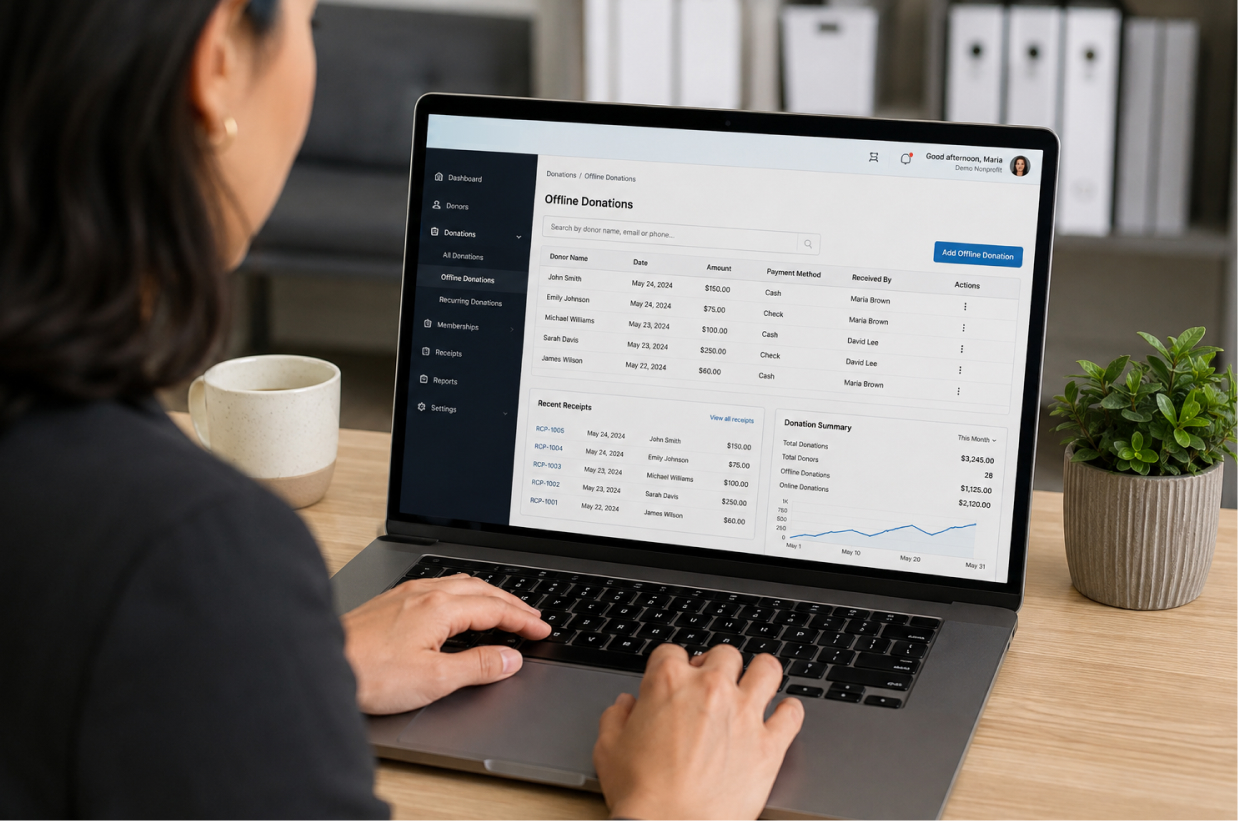
DonorKite helps nonprofit organizations maintain donor information, record offline donations, generate donation receipts, and manage donation histories from a centralized platform.
Rather than keeping donor information in one spreadsheet and receipts in another folder, nonprofits can maintain contribution records against individual donor profiles.
This makes it easier to understand a donor's giving history and prepare appropriate receipts from recorded contribution information.
DonorKite also supports sending receipts through communication channels such as email, WhatsApp, and SMS, helping organizations reduce the repeated manual work involved in preparing and distributing donor acknowledgments.
During year-end giving, this centralized approach can be particularly valuable.
Staff can continue recording contributions as they arrive instead of postponing data entry until January.
When donors request receipt copies or year-end giving information, staff have a clearer record of previous contributions and acknowledgments.
DonorKite is designed specifically around donor management, offline donation records, receipt administration, and related nonprofit workflows. It is not an online donation payment gateway.
For organizations that primarily need a reliable way to organize offline contributions and charitable receipts for donations, this focused approach can help simplify year-end administration.
A Practical Year-End Receipt Workflow for Nonprofits
The strongest year-end process begins before December becomes busy.
Nonprofits should first review their donor database and correct obvious duplicates or incomplete information.
As contributions arrive, staff should record them consistently and connect each donation with the correct donor.
Receipt information should be generated from verified contribution records rather than manually recreated from separate notes or bank records.
Organizations should regularly review December donations instead of waiting until the entire month is over.
Near the end of the year, nonprofits can then check outstanding records, investigate missing donor information, and prepare annual donor statements from a more complete contribution history.
This approach spreads administrative work across the giving period rather than concentrating everything into the first few weeks of January.
Common Year-End Donation Receipt Mistakes to Avoid
Several mistakes repeatedly create problems for nonprofits during year-end giving.
One is waiting until January to organize December donations.
Another is maintaining donor information in multiple independent spreadsheets.
Organizations may also generate receipts manually without recording whether they were actually issued.
Duplicate donor profiles can create incomplete annual histories, while incorrect contact information can prevent receipts from reaching supporters.
Nonprofits should also be careful when dealing with non-cash gifts or contributions where goods or services were provided in return. These situations may require different acknowledgment information from straightforward monetary donations.
Most of these problems can be reduced through consistent processes and centralized records.
The goal is not simply to generate receipts faster.
It is to ensure that the information behind every receipt is reliable.
Build a Better Year-End Giving Process
Year-end giving should be an opportunity for nonprofits to strengthen their missions, not a period followed by weeks of administrative cleanup.
A reliable process for charitable receipts for donations starts with accurate donor data.
Each contribution should be recorded promptly and connected to the right supporter.
Organizations should understand applicable IRS donation receipt requirements, use consistent acknowledgment formats, keep receipt records accessible, and prepare annual statements from complete donation histories rather than manually reconstructing them after the year ends.
As donation volumes increase, donor software can help reduce repetitive work and improve the connection between donors, contributions, receipts, and reporting.
For nonprofits still relying heavily on spreadsheets and manually prepared documents, moving toward a centralized system can make year-end giving considerably easier to manage.
DonorKite helps nonprofits organize donor information, manage offline donations, create donation receipts, maintain contribution histories, and keep year-end receipt administration more organized from one platform.
Instead of entering the new year with hundreds of receipts left to prepare, nonprofits can build a process in which each contribution is recorded accurately, acknowledged appropriately, and ready to be included in year-end donor reporting when needed.
Make year-end giving easier to manage with DonorKite. Start DonorKite 7 days free trial today to organize donor records, offline contributions, and charitable receipts for donations from one centralized system.