
Small nonprofits rarely begin with complicated technology. A spreadsheet, a shared inbox and a few folders may be enough when an organization has a small number of donors and only a handful of donations to record each month.
The difficulty starts when that simple system has to handle hundreds of donor records, repeat contributions, multiple funds, donation receipts, annual statements, reporting and questions from donors about their previous giving.
At that point, finding the right Donor Management Software for Small Nonprofits becomes less about adding technology and more about removing administrative work.
The best system should give a small nonprofit one reliable place to maintain donor information, record donations, review giving history, manage receipts and understand fundraising records without forcing staff or volunteers to learn an enterprise-level CRM.
That is why choosing donor management software requires more than comparing feature lists. Small nonprofits need to consider usability, donation management, donor records, receipt administration, reporting, cost and how easily the software fits into their everyday workflow.
For organizations looking for a simpler system built around these needs, Donor Management Software for Small Nonprofits can help centralize donor and donation administration without relying on disconnected spreadsheets.
This guide explains what to evaluate before choosing donor management software in 2026, with a primary focus on nonprofits in the United States and additional considerations for organizations in Canada, the United Kingdom, Australia and New Zealand.
Why Small Nonprofits Are Moving Beyond Spreadsheets in 2026
Spreadsheets are not necessarily a problem when a nonprofit is new. They are familiar, inexpensive and flexible.
The problem is that a spreadsheet is a file, not a donor management system.
As giving activity increases, nonprofits may end up maintaining one spreadsheet for donor information, another for donations, separate folders for receipts and additional files for campaigns, annual giving totals and reporting.
Staff then spend time asking basic administrative questions that should be easy to answer.
Has this donor contributed before? Which fund received the donation? Was a receipt already issued? What did this donor give during the previous year? Is this the latest donor address? Are two similar records actually the same person?
This is where dedicated Donor Management Software starts to provide practical value.
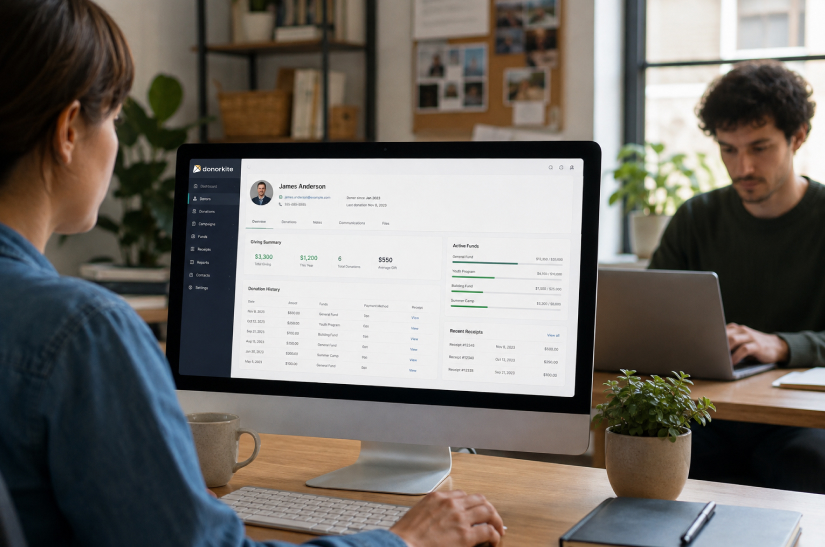
Instead of continually expanding a manual system, Donation Management Software can bring donor profiles, giving histories, donation records, funds, receipts and reports into a more structured workflow.
Organizations comparing these approaches can explore donation management software vs manual administration to understand where manual processes typically become difficult to maintain.
For a small nonprofit, the objective should not be to buy the platform with the longest list of features. It should be to reduce unnecessary administration while improving the accuracy and accessibility of donor information.
If that is the problem your organization is currently trying to solve, try DonorKite free for 7 days and explore the workflow using your nonprofit's everyday donation-management requirements.
What Donor Management Software for Small Nonprofits Should Actually Do
A useful system should help with the work nonprofit teams perform repeatedly.
That begins when a donor needs to be added or located, continues when a donation is recorded and extends through receipt generation, reporting and reviewing the donor's history later.
The most important capabilities are therefore not necessarily advanced automation or hundreds of integrations. For many small organizations, reliable core administration delivers far more value.
Keep Donor Information in One Organized Database
A nonprofit donor database should provide one dependable profile for each donor rather than forcing staff to search multiple spreadsheets.
Contact information, donation history and other relevant donor details should remain connected to the same record.
This becomes especially important when multiple people help administer the organization. A volunteer should not maintain one version of a donor's details while another employee works from an older spreadsheet.
The best donor database for small nonprofits should therefore make records easy to find, update and review without requiring technical expertise.
Good database management also reduces duplicate donor profiles. Duplicates can distort donor counts, separate a supporter's giving history and make reporting less reliable.
Before moving data into any new system, it is worth reviewing how to organize a nonprofit donor database so that inaccurate or unnecessary records are not simply transferred into the new platform.
Track Donations Without Rebuilding Records Every Time
Donation Management Software should connect every contribution to the appropriate donor record.
Instead of entering the donor's details repeatedly, staff should be able to locate the donor, add the donation amount, select the relevant fund or campaign, record the payment method and preserve the contribution within the donor's history.
This matters particularly for small nonprofits receiving donations through cash, checks, bank transfers and other methods that may otherwise be tracked manually.
Over time, this creates a much clearer picture of individual giving.
A staff member should be able to open a donor record and understand that supporter's contribution history without searching old spreadsheets, emails or receipt folders.
This is one of the main reasons donor software for nonprofits becomes valuable even before an organization reaches enterprise scale.
Make Donation Receipts Easier to Manage
Donation receipts for nonprofits are another major source of repetitive administrative work.
A small organization may initially create every receipt manually using a document template. That process becomes increasingly difficult when donation volume grows.
The staff member preparing the receipt must confirm the donor, amount, date, organization information and applicable receipt details before creating the document, sending it and keeping a record of what was issued.
Good nonprofit donor software should connect receipt administration directly with the donation record.
That reduces the need to re-enter information and makes previous documentation easier to find.
Organizations reviewing their current receipt format can use these donation receipt samples for nonprofits to better understand how donation documentation can be structured.
Receipt requirements are not identical in every country, which makes organized recordkeeping particularly important for nonprofits operating under different tax frameworks.
A dedicated guide to donation receipts for nonprofits can also help organizations understand how receipt administration connects with their broader donation-management process.
Support Donor Relationships With Better Information
Donor engagement software can sound as though software itself creates relationships. It does not.
Relationships still depend on appreciation, relevant communication, transparency and meaningful engagement from the nonprofit.
Where donor management systems can help is by giving staff better information before those interactions happen.
If a nonprofit can quickly see whether someone is a first-time donor or a long-term supporter, which causes they previously supported and when they last contributed, staff have better context for their communication.
That is an important distinction when evaluating donor engagement software.
The system should support the relationship rather than pretending to replace it.
Organizations working to strengthen repeat giving can also review these nonprofit donor retention strategies alongside their software decision.
Provide Reports Without Hours of Manual Preparation
Reporting is another area where spreadsheets frequently become inefficient.
A nonprofit may need to review donations by period, fund or campaign, understand overall giving activity or prepare information for leadership.
If every report requires merging several files, checking formulas and cleaning duplicate records, the reporting system is consuming time rather than saving it.
Donor management systems for nonprofits should make existing donation information easier to review.
The organization should not have to recreate its data every time someone asks a different question about fundraising activity.
What to Look for in the Best Donor Management Software
When comparing the best donor management software, evaluate how each system handles the activities your organization performs every week rather than choosing based on the largest number of advertised features.
What to Evaluate | Why It Matters for a Small Nonprofit | What to Check Before Choosing |
Donor database | Creates one organized source for donor information | Can staff quickly find profiles, donation histories and current contact details? |
Donation tracking | Keeps contributions connected with donors | Can donations be recorded consistently with funds and payment methods? |
Donation receipts | Reduces repetitive receipt administration | Can receipts be created from recorded donation information and easily retrieved later? |
Funds and campaigns | Improves organization of giving records | Can staff assign contributions to the appropriate fund or campaign? |
Reporting | Reduces spreadsheet compilation | Can common donation information be reviewed without manually rebuilding reports? |
Ease of use | Small teams may not have dedicated CRM administrators | Can staff and volunteers understand routine workflows quickly? |
Data migration | Existing records need to move into the new system | Can donor information be imported without excessive manual re-entry? |
Scalability | Today's small database may grow | Will the system remain manageable as donors and donation records increase? |
Receipt flexibility | Requirements vary between organizations and countries | Can receipt information be configured around the organization's needs? |
Pricing | Small nonprofits typically operate with limited budgets | Are the core features included without unnecessary enterprise modules? |
The best donor management software is therefore not automatically the product with the most automation, integrations or enterprise features.
For a small nonprofit, simpler can be better when simplicity means staff actually use the system consistently.
Donor Management Software, Donation Management Software and Nonprofit CRM: What Is the Difference?
These terms frequently overlap, which makes software research confusing.
Donor Management Software generally focuses on maintaining donor profiles, contribution histories and information related to the donor relationship.
Donation Management Software puts greater emphasis on the contribution itself: recording amounts, funds, payment methods, receipts and donation reports.
Nonprofit donor software may combine both.
A nonprofit CRM can be broader still, potentially including donor management, fundraising activities, communications and other constituent relationships.
Organizations comparing wider CRM capabilities can review this guide to the Best Nonprofit CRM Software before deciding whether they genuinely need a broad CRM or primarily need stronger donor and donation administration.
The term fundraising and donor management software is also commonly used for platforms that combine donor records with fundraising-related functionality.
However, small nonprofits should look closely at what "fundraising" means within each product.
Some fundraising and donor management software processes online payments, builds donation pages and runs digital fundraising campaigns. Other systems are primarily designed to organize the administrative side of donations after they are received.
Neither approach is automatically better. The right choice depends on the problem your organization is trying to solve.
If your primary challenge is keeping donor information, donation histories, receipts, funds and reports organized, buying an unnecessarily complex fundraising suite can increase cost and training requirements without fixing the actual workflow problem.
Finding the Best Donor Database for Small Nonprofits
The best donor database for small nonprofits should make donor information easier to work with, not simply move a spreadsheet into a more complicated interface.
1. Start with searchability.
If a donor contacts your organization and asks about an earlier contribution, how quickly can a staff member locate the correct profile and review the giving history?
2. Then consider data structure.
Can multiple contributions remain connected to one donor? Can staff update donor information without modifying historical donation records? Can the organization understand the complete relationship rather than viewing each contribution as an isolated transaction?
3. Finally, consider maintenance.
A database remains useful only when people keep it accurate. If updating a donor profile takes too many steps, staff may begin keeping notes somewhere else. Once that happens, the organization gradually returns to fragmented records.
A good nonprofit donor software platform should make the correct process easier than the workaround.
This is especially important when a small organization has limited administrative staff and depends on volunteers.
Rather than selecting software based only on a demonstration, enter several realistic donor and donation scenarios during the trial period.
Add an existing donor. Record another contribution. Find an older gift. Update a donor's information. Review the donation history. Locate the receipt. Run a report.
If those basic tasks feel difficult during a trial, they are unlikely to become easier when staff are busy.
You can register for DonorKite and use the 7-day trial to test these everyday workflows before deciding whether it fits your organization.
Donor Software for Nonprofits Should Connect the Entire Administrative Workflow
One of the biggest weaknesses of disconnected tools is that a simple donation can create work in several places.
The donor may be added to one spreadsheet. The contribution may be recorded in another. The receipt may be created separately. Campaign totals may exist somewhere else.
Donor software for nonprofits should reduce these handoffs.
The ideal workflow is straightforward: locate or create the donor, record the donation, assign the required details, preserve it within the donor's history and complete the necessary receipt administration.
This is why organizations should evaluate software based on workflows rather than isolated features.
A product may claim to have donor management, receipt management and reporting, but those features provide limited value if staff still have to enter the same information three times.
For a deeper look at how these processes connect in everyday nonprofit administration, see donor software for nonprofits.
What US Small Nonprofits Should Consider
The United States is the primary market where many organizations search for Donor Management Software for Small Nonprofits because donor administration and charitable contribution documentation can become difficult to manage as an organization grows.
US nonprofits should look for software that maintains reliable donor identities, donation dates, contribution amounts and donation histories while making acknowledgement and receipt administration easier.
The organization should also consider how its system supports the records needed for charitable contribution acknowledgements and tax documentation.
A tax receipt is not merely a thank-you message. Depending on the contribution and circumstances, specific information may be relevant to the donor's tax records.
That makes receipt accuracy and record retention important parts of donor administration.
Organizations reviewing this area can read DonorKite's guide to creating a tax-deductible receipt.
For US nonprofits, the best donor management software should also be realistic about staffing.
A community nonprofit with a small administrative team usually does not need an enterprise CRM requiring extensive configuration and a dedicated administrator.
It needs a system people will actually use when a check arrives, a donor calls, a receipt needs to be sent or leadership needs a donation report.
That usability should carry more weight than impressive but unnecessary functionality.
Choosing Donor Management Software in Canada
Canadian organizations should apply the same operational criteria while also considering the requirements that apply to official donation receipts.
Registered charities in Canada may need to maintain specific donor and gift information when issuing official donation receipts.
This makes structured donation records, reliable donor information and consistent receipt management especially useful.
The best donor database for small nonprofits in Canada should make it easier to keep donor details and giving history together rather than maintaining receipt data separately from the donor database.
Canadian nonprofits should also confirm that the software they select can support the information their organization needs to place on receipts and preserve within its records.
The objective is not simply to produce a PDF. The entire record behind the receipt should remain accurate and accessible.
What UK Charities Should Look for
In the United Kingdom, small charities may need to maintain giving records alongside Gift Aid information and other fundraising administration.
For these organizations, donor management systems should provide a reliable structure for maintaining supporter details and donation history.
UK charities should avoid assuming that every fundraising and donor management software platform is designed around their workflow simply because it describes itself as a nonprofit CRM.
Evaluate how easily the system handles routine giving administration and how much configuration is necessary before staff can use it productively.
A smaller charity often benefits more from a focused donor management system than from a complex CRM containing features designed for large fundraising departments.
Usability, accurate records, accessible histories and straightforward reporting should remain central to the selection process.
Donor Management Software for Australian Nonprofits
Australian charities and nonprofit organizations should consider how their donation records connect with receipt administration and, where relevant, deductible gift recipient requirements.
As in other countries, accurate donor and donation records are the foundation.
If the organization issues gift receipts, staff should be able to connect those documents with the underlying contribution rather than creating them independently in a word-processing application.
Donation Management Software can help establish that consistent administrative process.
For smaller Australian organizations, ease of use is again important. Software should reduce the amount of manual work required to manage donors and contributions rather than introducing a more complicated system simply because it contains additional modules.
Donor Management Systems for Nonprofits in New Zealand
New Zealand charities and approved donee organizations also have local donation receipt considerations.
Keeping the donor, contribution amount, donation date and relevant receipt information properly organized can make administration significantly easier.
Small New Zealand nonprofits should therefore evaluate donor management systems for nonprofits based on data quality as well as features.
Can the system help staff locate the correct donor and contribution? Is the receipt connected to the donation? Can previous giving be reviewed without searching several files? Can staff maintain consistent records year after year?
Those questions are more important than whether the software contains dozens of features the organization will never use.
How Donor Engagement Software Fits Into the Decision
Donor engagement software deserves careful evaluation because the term is used broadly.
Technology can give nonprofits better information. It can help staff see contribution histories, identify returning supporters and understand which funds or campaigns a donor has supported.
But software does not create genuine appreciation.
The strongest donor engagement comes from what the organization does with reliable information.
A donor who has supported the same cause for several years should be recognized accordingly. A first-time donor may require a different type of acknowledgement. Someone requesting an old receipt should receive an accurate response without waiting while staff search several spreadsheets.
This is why donor management and donor engagement are closely connected.
Good donor management systems create the administrative foundation from which better donor experiences can be delivered.
When evaluating donor engagement software, therefore, ask whether its features genuinely help your team understand and serve supporters or simply add more functionality to manage.
Questions to Ask Before Choosing a Donor Management System
Before signing up for a platform, test it against the real needs of your organization:
Can our team maintain one accurate donor profile and complete donation history?
Can we record the types of donations our organization actually receives?
Can we organize donations by relevant funds or campaigns?
Can donation receipts be generated and managed without repeatedly entering the same information?
Can staff find previous receipts and donation records quickly?
Can we produce the reports our leadership actually uses?
Can existing donor data be moved into the system without rebuilding everything manually?
Can volunteers or occasional users understand the basic workflow?
Does the pricing make sense for a small nonprofit as its donor database grows?
Are we paying for capabilities we genuinely need rather than an enterprise feature set we are unlikely to use?
The answers will usually reveal far more than a long software-comparison checklist.
Why DonorKite Is Worth Considering for Small Nonprofits
For small organizations, good software should make everyday work more organized without turning donor administration into a technical project.
DonorKite is designed around that principle.
Organizations can keep donor information and donation history together, record donations, organize giving by funds and campaigns, manage donation receipts and review donation reports within one cloud-based system.
This makes DonorKite particularly relevant to nonprofits trying to move away from fragmented spreadsheets and manual donation administration.
Instead of focusing on unnecessary complexity, the system is designed around the tasks staff regularly perform when managing donors and donations.
That includes maintaining donor records, connecting donations with the right supporter, preserving contribution histories, generating receipts and making information easier to retrieve later.
For a small nonprofit, these practical capabilities can be more valuable than purchasing a broad enterprise platform and using only a small percentage of it.
DonorKite can also be evaluated before your organization commits to it. Try DonorKite for free for 7 days and test it with the same donor and donation workflows your team manages today.
Avoid Buying More Software Than Your Nonprofit Needs
One of the most common mistakes when searching for the best donor management software is assuming that more features always mean better value.
They do not.
A small nonprofit can buy sophisticated fundraising and donor management software containing advanced marketing automation, complex workflow builders and enterprise integrations, then continue using spreadsheets because staff find the new platform too difficult.
Software only creates value when it becomes part of the organization's actual workflow.
Look at what currently consumes administrative time.
If staff struggle with duplicate donor records, prioritize the donor database.
If recording contributions takes too long, prioritize donation management.
If donation receipts for nonprofits are being prepared manually, prioritize receipt administration.
If staff cannot understand a donor's previous support, prioritize contribution history.
If leadership waits several days for basic giving reports, prioritize accessible reporting.
The best donor management software solves those problems first.
Additional functionality can matter later, but core processes should remain simple from day one.
When Is It Time to Move to Dedicated Nonprofit Donor Software?
There is no universal donor count at which every organization must stop using spreadsheets.
A nonprofit with 500 well-maintained donor records may have fewer administrative problems than an organization with 100 donors spread across several inconsistent files.
Instead, look for operational warning signs.
If donor records are frequently duplicated, receipts are difficult to retrieve, staff repeatedly re-enter the same information, giving histories are incomplete or reports require hours of manual compilation, the existing system is beginning to create unnecessary work.
That is usually the point at which nonprofit donor software deserves serious consideration.
Donor management systems are not only for large organizations. In many cases, a small team has an even greater need to reduce repetitive administration because there are fewer people available to handle it.
The goal is to give that team one dependable process.
Choosing the Best Donor Management Software for Your Small Nonprofit in 2026
Choosing Donor Management Software for Small Nonprofits should begin with the problems your organization needs to solve, not with a vendor's longest feature list.
The most useful platform will make donor records easier to maintain, donations easier to track, giving histories easier to understand, donation receipts easier to manage and reports easier to access.
For US nonprofits, those capabilities can also support more organized charitable contribution and receipt administration. The same underlying need exists for organizations working with CRA donation receipts in Canada, Gift Aid-related records in the United Kingdom, DGR gift administration in Australia and IRD donation receipts in New Zealand.
Across every market, the principle is similar: accurate donor data should not live across disconnected spreadsheets and folders.
A good donor management system gives a nonprofit one organized foundation for managing the information surrounding every contribution.
DonorKite provides that foundation through centralized donor records, donation management, funds and campaigns, donation receipts, donor histories and reporting built around everyday nonprofit administration.
If your nonprofit is ready to replace scattered records with a more structured system, start your 7-day free trial of DonorKite and evaluate the platform using your own donor-management workflow before making your decision.
Frequently asked questions
What is the best donor management software for small nonprofits?
The best donor management software for small nonprofits is one that makes donor records, donation history, receipts, funds, campaigns and reporting easy to manage without requiring a complex enterprise CRM. Small nonprofits should prioritize usability, accurate donor data, simple donation tracking and straightforward reporting. DonorKite is designed around these everyday administrative needs, helping organizations keep donor and donation information organized in one place.
What should a small nonprofit look for in donor management software?
A small nonprofit should look for donor management software that provides a centralized donor database, donation history, receipt management, funds and campaign tracking, reporting, data import and an easy-to-use interface. The software should reduce manual administration rather than create additional work. It is also important to check whether the system fits the nonprofit's actual workflow and can remain practical as the donor database grows.
What is the difference between donor management software and donation management software?
Donor management software primarily focuses on donor profiles, giving history and donor relationships, while donation management software focuses more on recording contributions, funds, payment methods, receipts and donation reports. Many modern donor management systems combine both functions. Small nonprofits generally benefit from a platform that keeps donor information and donation records connected rather than maintaining separate systems for each.
Can donor management software create donation receipts for nonprofits?
Yes. Many donor management systems can generate donation receipts from recorded contribution information, which helps reduce manual data entry and makes previous receipts easier to locate. Organizations should still ensure that their receipts contain the information required under applicable local rules. This is especially important for nonprofits operating in the United States, Canada, the United Kingdom, Australia or New Zealand.
For more information about receipt administration, see Donation Receipts for Nonprofits.
How much does donor management software cost for a small nonprofit?
Pricing varies depending on the platform, number of users, donor records and included features. Some donor management systems charge by contact count, while others use monthly subscription plans or feature-based pricing. Small nonprofits should compare the total cost against the functions they actually need instead of choosing software with expensive enterprise features they may never use. A trial period can also help determine whether the software provides enough value before committing.
Is donor management software useful for nonprofits in the USA, Canada, UK, Australia and New Zealand?
Yes. The core need to maintain accurate donor records, donation histories and receipts exists across all five markets, although receipt and tax requirements differ by country. US nonprofits may work with IRS charitable contribution acknowledgement requirements, Canadian charities with CRA official donation receipts, UK charities with Gift Aid records, Australian organizations with ATO and DGR requirements, and New Zealand organizations with IRD donation receipt requirements. The software should support organized recordkeeping while the nonprofit remains responsible for meeting its applicable local requirements.
Is DonorKite suitable for small nonprofits?
DonorKite can be a strong option for small nonprofits that want to organize donor records, donation history, funds, campaigns, receipts and donation reporting without relying on multiple spreadsheets and disconnected files. It is particularly useful for organizations looking for a focused donor and donation management workflow rather than an overly complex enterprise system.
Small nonprofits can try DonorKite free for 7 days and test the platform using their own everyday donor-management workflow before deciding whether it is the right fit.