
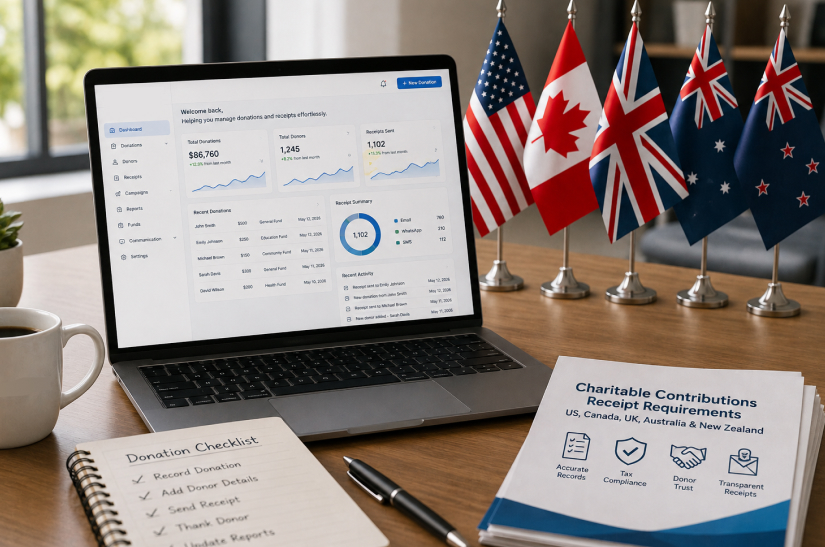
Charitable organizations receive contributions in many forms, from cash and cheque donations to bank transfers, property, securities, church offerings, fundraising gifts and other eligible contributions. Recording those donations correctly is important not only for internal accounting but also for donor communication, tax documentation and long-term recordkeeping.
However, Charitable Contributions Receipt Requirements are not the same in every country.
A nonprofit organization in the United States may need to follow IRS donation receipt requirements and charitable contribution acknowledgement rules. A registered charity in Canada may issue an official donation receipt that must contain information prescribed by the Canada Revenue Agency. UK charities have a different framework built around Gift Aid declarations and Gift Aid record keeping. Australian organizations need to understand DGR status and relevant donation receipt requirements, while New Zealand charities and donee organizations must consider IRD donation receipt requirements and donation tax credit documentation.
That means charities operating in the United States, Canada, the United Kingdom, Australia and New Zealand should not rely on a single generic receipt template.
Instead, organizations need to understand the charitable donation receipt requirements relevant to their location and maintain enough donor and donation information to produce the correct documentation when needed.
This guide explains the Charitable Contributions Receipt Requirements in 2026 across all five countries, including important terminology, receipt information, donor acknowledgement rules, Gift Aid records, DGR considerations, IRD requirements and practical ways to organize donation records more efficiently.
For organizations still managing donations through spreadsheets, Word documents and separate PDF receipts, DonorKite provides a more structured way to manage donor records, offline donations, receipts, campaigns and reporting. Organizations can register with DonorKite and try the platform free for 7 days before deciding whether it fits their workflow.
What Are Charitable Contributions Receipt Requirements?
Charitable Contributions Receipt Requirements refer to the tax, documentation and recordkeeping rules that apply when a charity, nonprofit, church or other eligible organization records and acknowledges a donation.
The exact donation receipt requirements depend on the country, type of contribution, organization receiving the gift, amount donated and whether the donor receives goods or services in exchange.
Different countries also use different terminology.
In the United States, organizations often refer to a charitable contribution acknowledgement or donation receipt. Canadian registered charities use the term official donation receipt. UK charities frequently deal with Gift Aid declarations and Gift Aid records rather than a tax receipt system identical to the US or Canada. Australian organizations may issue a DGR donation receipt, while New Zealand donors may use an IRD donation receipt when claiming an eligible donation tax credit.
These terms are related, but they should not be treated as interchangeable.
A US charitable contribution acknowledgement is not the same document as an official donation receipt issued in Canada. Likewise, a UK Gift Aid declaration performs a different function from an Australian DGR receipt or New Zealand donation tax credit receipt.
Understanding those distinctions is one of the most important parts of meeting charitable donation receipt requirements accurately.
Why Donation Receipt Requirements Differ Across Countries
Charitable tax systems are designed differently in each jurisdiction.
The United States focuses heavily on donor substantiation and written acknowledgement for certain charitable contributions. Canada has highly detailed CRA donation receipt requirements for official tax receipts. The United Kingdom places significant importance on valid Gift Aid declarations and the audit trail between the donor, declaration and donation.
Australia operates through the Deductible Gift Recipient framework, meaning an organization's DGR status can affect whether a donation is tax deductible. New Zealand uses IRD rules for donation receipts and donation tax credits.
Because these systems are different, charities should avoid downloading one generic donation receipt template and using it everywhere.
The stronger approach is to understand the relevant charity donation receipt requirements, collect complete donor and donation information at the point of entry, and create the correct receipt or acknowledgement based on the applicable jurisdiction.
Charitable Contributions Receipt Requirements by Country
The five target countries can be summarized broadly as follows:
Country | Main Authority | Common Documentation | Primary Focus |
United States | IRS | Charitable contribution acknowledgement | Donation substantiation and benefits received |
Canada | CRA | Official donation receipt | Detailed mandatory receipt information |
United Kingdom | HMRC | Gift Aid declaration and records | Valid declarations and donation audit trail |
Australia | ATO | DGR donation receipt | DGR eligibility and qualifying gifts |
New Zealand | IRD | Donation receipt | Donation tax credit documentation |
This comparison is useful as an overview, but the specific donation receipt requirements within each country deserve closer attention.
United States Charitable Contributions Receipt Requirements
The United States has one of the most established frameworks around charitable donation documentation.
For US nonprofits, churches, foundations and other qualified organizations, IRS donation receipt requirements matter because donors may need specific documentation to substantiate charitable deductions on their federal tax returns.
The rules vary depending on the amount and nature of the contribution.
IRS Donation Receipt Requirements for Monetary Contributions
For monetary charitable contributions, donors generally need an appropriate record showing that the donation was made to a qualified organization.
This record may come from a bank record or written communication from the organization showing the organization's name, contribution amount and contribution date.
Even where a particular donation is below a higher acknowledgement threshold, organizations often provide donors with a written donation acknowledgement because it creates a clearer record for both sides.
Consistent documentation also reduces year-end questions from donors who may otherwise contact the organization months later asking for proof of their contribution.
The IRS $250 Donation Rule
One of the most important IRS donation receipt requirements involves contributions of $250 or more.
A donor generally needs a contemporaneous written charitable contribution acknowledgement from the qualified organization for a single contribution of $250 or more.
The acknowledgement should generally identify the amount of a monetary donation or describe non-cash property received. It should also state whether the organization provided any goods or services in exchange for the donation.
If goods or services were provided, the acknowledgement may need to include a good-faith estimate of their value. If nothing was provided in return, the organization should state that clearly.
This is why the IRS $250 threshold is such an important operational point for nonprofits receiving larger donations.
Organizations should have a reliable process for identifying qualifying contributions and issuing the appropriate acknowledgement without relying on staff to manually notice every transaction.
For additional detail, organizations can review DonorKite's guide to the IRS $250 donation rule.
Charitable Contribution Acknowledgement Requirements
A charitable contribution acknowledgement is not simply a thank-you message when it is being relied on for tax substantiation.
The wording should accurately describe what happened.
If a donor received no goods or services in exchange for the donation, the acknowledgement should reflect that. If a donor did receive something of value, the organization should not automatically describe the entire payment as tax deductible.
That distinction becomes particularly important at fundraising dinners, charity events, auctions and membership programs where a donor may receive a benefit.
The stronger the organization's donation records are, the easier it becomes to apply the correct donation acknowledgement requirements.
Quid Pro Quo Contributions
A quid pro quo contribution happens when a donor makes a payment partly as a charitable gift and partly in exchange for goods or services.
For example, a donor might pay to attend a fundraising dinner and receive a meal as part of the transaction.
In those cases, the full payment should not automatically be treated as a charitable gift. Different disclosure rules may apply, and the value of the benefit may need to be considered.
This is why charities should record more than just the final amount received.
They should also know whether a benefit was provided, what type of event or transaction generated the payment, and whether the payment was a pure contribution.
Non-Cash Donations in the United States
US charitable donation receipt requirements can become more complex when the donor gives property instead of money.
Non-cash gifts can include furniture, vehicles, equipment, securities, artwork, clothing and other property.
The charitable organization generally describes the property received rather than assigning the donor's claimed tax value to it. Depending on the value and type of gift, additional donor-side appraisal or IRS reporting requirements may apply.
Organizations accepting these contributions therefore need to preserve an accurate description of what was received and keep that information connected to the correct donor.
For a more detailed explanation, see DonorKite's guide to non-cash donation receipts.
Common US Receipt Problems
Many US donation receipt problems are operational rather than intentional.
Organizations may forget to state whether goods or services were provided, lose old acknowledgement records, mix receipts from different campaigns, issue inconsistent wording or fail to distinguish non-cash donations from monetary gifts.
These problems become more common when donor data, donation records and receipts are maintained separately.
Following consistent IRS donation receipt requirements becomes much easier when every donation is connected to a complete donor history.
Canada CRA Donation Receipt Requirements
Canada uses one of the more formal charitable receipting systems among the five countries covered in this guide.
For Canadian registered charities, understanding CRA donation receipt requirements is essential because an ordinary thank-you letter is not necessarily an official receipt for income tax purposes.
An official donation receipt Canada registered charities issue is a formal tax document that needs to contain prescribed information.
What Is an Official Donation Receipt in Canada?
An official donation receipt is issued by a registered charity or other qualified donee when an eligible gift meets the necessary conditions.
It is not simply a confirmation that money was received.
The receipt needs to contain information prescribed by the CRA, making Canadian charitable donation receipt requirements particularly important for organizations issuing large volumes of receipts.
Information Required on an Official Donation Receipt
A qualifying CRA official donation receipt may need to contain information including the charity's legal name and address, CRA registration number, a unique receipt serial number, the donor's full name and address, the amount of the gift, the receipt issue date and the date or year the donation was received.
Where a donor received an advantage, the receipt may also need to reflect the value of that advantage and the eligible amount of the gift.
The official receipt should also contain other required information relevant to the type of contribution.
Because the CRA donation receipt requirements are detailed, incomplete donor records can create problems later.
If the organization does not collect the correct donor name, address, gift details or advantage information at the time of donation, creating the proper official receipt becomes more difficult.
Eligible Amount of a Gift
One of the most important concepts in Canadian charitable receipting is the eligible amount of the gift.
A donor may provide money to a charity but also receive something in return.
When that happens, the charity may need to calculate the value of the advantage and deduct it from the contribution to determine the eligible amount.
For example, someone could make a payment connected to an event where food, entertainment or another benefit is provided.
The full payment should not automatically be treated as the eligible charitable amount.
This is an important part of CRA donation receipt requirements and one reason organizations need to keep accurate transaction information rather than only recording the final payment received.
Does Every Canadian Donation Require an Official Receipt?
A registered charity does not necessarily have to issue an official receipt for every donation it receives.
Organizations may establish their own receipting practices, including minimum amounts or annual receipting procedures.
However, donors who want to claim the applicable charitable tax credit generally need suitable official documentation.
That is why many charities still establish consistent receipting policies even when every contribution does not automatically generate a receipt.
Year-End Receipts in Canada
Some Canadian charities issue an official donation receipt after each qualifying donation, while others provide cumulative receipts covering multiple eligible donations.
For organizations using annual receipts, reliable donor history becomes particularly important.
If a donor contributed ten or twelve times during the year, the charity needs a complete history showing each contribution, amount, date and any relevant advantage before preparing the final receipt.
This is one reason manual spreadsheets can become difficult to maintain as donation volume grows.
Organizations wanting a deeper Canada-specific guide can read about donation receipt software for Canadian registered charities.
Common CRA Receipt Problems
Typical problems include missing donor information, incorrect eligible amounts, duplicate receipt numbers, incomplete charity registration details and confusion between ordinary acknowledgements and official donation receipts.
The best way to meet CRA donation receipt requirements consistently is to ensure the underlying donor and donation records are accurate before a receipt is generated.
United Kingdom Gift Aid Record Keeping and Donation Documentation
The United Kingdom has a different charitable tax environment from the United States and Canada.
UK organizations should therefore avoid interpreting Charitable Contributions Receipt Requirements as though a US-style tax receipt automatically applies.
For many UK charities, the more important tax concepts are Gift Aid declaration requirements and Gift Aid record keeping.
Gift Aid and Donor Documentation
Gift Aid allows eligible charities and Community Amateur Sports Clubs to increase the value of qualifying donations when the relevant conditions are met.
To support eligible claims, charities need appropriate declarations from donors.
A valid declaration generally identifies the donor, the charity and the donation or donations being covered. It also needs to contain the appropriate Gift Aid statement and donor agreement.
That makes the declaration much more than a general receipt.
A donation acknowledgement can still be useful for donor communication, but it should not be confused with the declaration required for Gift Aid.
Gift Aid Declaration Requirements
Proper Gift Aid declaration requirements depend on obtaining enough information to establish that the donor wants eligible contributions to be treated under Gift Aid.
A declaration may cover a single gift, past gifts, future gifts or a combination depending on the circumstances.
This makes donor history especially important because charities may need to connect several different donations to one continuing declaration.
If donor declarations are stored separately from donation transactions, staff may have difficulty determining which donations are covered.
Gift Aid Record Keeping
Strong Gift Aid record keeping means maintaining a clear connection between the donor, the declaration and the relevant contribution history.
An organization should be able to identify who made the donation, when it was received, how much was donated, what declaration applies and whether the declaration was later cancelled or changed.
When all of those records are stored in different systems, administration becomes more complicated.
A charity may have a donor record in one spreadsheet, a declaration in an email attachment and transaction information somewhere else.
Centralizing the underlying donation history reduces that fragmentation.
Historical Gift Aid Records
Gift Aid records also need to be retained for the appropriate period.
This becomes especially important when declarations cover continuing donations rather than one single contribution.
Charities should therefore avoid deleting older donor records simply because a fundraising campaign has ended.
Reliable Gift Aid record keeping supports both compliance administration and better long-term donor management.
Donation Receipts in the UK
UK charities may still send donation receipts or acknowledgements.
These can confirm that a contribution was received, give donors a professional record and help the organization resolve future questions.
However, the receipt itself does not automatically replace the separate requirements associated with Gift Aid.
For more detail on the UK position, organizations can review DonorKite's guide to donation receipt requirements in the UK.
Australia DGR Donation Receipt Requirements
Australia also has its own terminology and tax rules for charitable giving.
Organizations researching donation receipt requirements Australia should begin by understanding Deductible Gift Recipient status.
Not every Australian charity or nonprofit is automatically a DGR, and not every payment made to a charitable organization automatically qualifies for a tax deduction.
What Is a DGR?
A Deductible Gift Recipient is an organization or fund eligible to receive certain tax-deductible gifts.
The recipient's DGR status is therefore important when determining whether a donor may be able to claim a deduction.
A DGR donation receipt should accurately reflect the nature of the contribution and the organization receiving it.
What Information Is Commonly Included on a DGR Donation Receipt?
Where a qualifying DGR receipt is issued, it should appropriately identify the relevant fund, institution or organization and include the ABN where applicable.
The receipt should also make clear that it relates to a gift.
Organizations commonly include additional operational details such as donor name, contribution date, donation amount and receipt number because this makes the document clearer for both the donor and the organization.
These details can also make it easier to maintain a reliable donation history.
Does Every Australian Donation Require a Receipt?
No.
The donation receipt requirements Australia organizations encounter do not mean a DGR must issue a receipt for every gift.
This distinction matters because charities should not create the impression that Australian tax rules require an identical receipt process for every contribution.
Even where a formal receipt is not universally mandatory, many organizations still choose to provide clear donation documentation because it supports better donor communication and internal administration.
Tax Deductible Donation Receipts in Australia
A tax deductible donation receipt Australia donors receive should not promise deductibility if the organization or contribution does not qualify.
Transactions requiring closer attention can include event tickets, auctions, memberships, merchandise purchases and other payments where goods or services are provided.
The organization should determine the nature of the transaction before describing the payment as a gift.
The underlying donation record should therefore capture enough information to distinguish a genuine gift from another type of payment.
For organizations looking for more operational guidance, DonorKite has a guide to receipt generators for Australian nonprofits.
New Zealand IRD Donation Receipt Requirements
New Zealand uses its own charitable donation terminology, and for both user clarity and SEO relevance the important tax authority is IRD, Inland Revenue.
Organizations should therefore understand IRD donation receipt requirements when issuing documentation that may support an eligible donor's donation tax credit claim.
An IRD donation receipt is more than a general thank-you message because it may be used as evidence that an eligible contribution was made.
What Are IRD Donation Receipt Requirements?
IRD donation receipt requirements cover the information that should appear on qualifying donation receipts.
The receipt generally needs to identify the donor, donation and organization clearly.
Important information may include the donor's full name, amount donated, contribution date or relevant tax year, a clear statement that the payment was a donation, the organization's name and IRD number, and relevant charity registration information where applicable.
Authorized-person information and an appropriate receipt number may also be relevant depending on the circumstances.
The goal is to create a record that clearly connects the donor to the qualifying donation.
Donation Tax Credit Receipt
A donation tax credit receipt can help an eligible New Zealand donor support a donation tax credit claim.
This makes receipt accuracy especially important.
If important information is missing, the donor may have difficulty relying on the document when making the claim.
Organizations should therefore avoid treating the receipt as nothing more than a generic acknowledgement.
The underlying donor and donation information should be correct before the receipt is generated.
IRD Donation Receipts for Churches
New Zealand churches and faith-based organizations may receive regular tithes, offerings and other charitable contributions.
Where those payments genuinely qualify as donations, they should be recorded clearly and connected with the correct donor information.
This is particularly important when a church receives many recurring donations throughout the year and later needs to provide suitable donation documentation.
Instead of trying to reconstruct a donor's annual giving from bank statements and spreadsheets, the organization should maintain a continuous donation history.
Replacement IRD Donation Receipts
Donors occasionally lose receipts and ask for replacements.
When this happens, the organization should be able to locate the original donation record and verify the correct donor, date, amount and receipt information.
A replacement receipt should be based on that original record rather than recreated from memory.
Reliable IRD donation receipt requirements therefore depend not only on the final receipt but also on the quality of the organization's underlying donation records.
For more detailed New Zealand guidance, organizations can read DonorKite's dedicated guide to IRD donation receipt requirements.
What Information Should Organizations Record for Every Donation?
Although the exact Charitable Contributions Receipt Requirements differ between countries, organizations benefit from maintaining a consistent internal record for every contribution.
At a minimum, the donation record should make it possible to identify who gave the donation, when it was received, how much was contributed, how the payment was received and which fund or campaign received it.
Where appropriate, the organization should also record donor contact information, receipt number, receipt issue date, whether the receipt was replaced and whether any goods or services were provided in connection with the contribution.
This information becomes particularly useful when an organization needs to create annual receipts, resolve donor questions or review past contributions.
The legal requirements may vary, but good internal records support every jurisdiction.
Offline Donations Create Additional Receipt Challenges
Offline donations are often where receipt administration becomes most difficult.
A charity may receive cash during an event, cheques through the post, bank transfers directly into its account and contributions handed to staff or volunteers.
Each donation needs to be identified and connected with the right donor.
If those transactions are recorded inconsistently, meeting donation receipt requirements becomes more difficult later.
For example, one staff member might record cash contributions in a spreadsheet while another tracks bank transfers through accounting software. Receipt PDFs may then be saved in a separate folder, while donor contact details are stored elsewhere.
When the donor asks for a replacement document months later, the organization has to search across several systems.
Organizations processing substantial volumes of cash giving can explore cash donation management software to create a more structured record of offline contributions.
Why Spreadsheets Become Difficult as Donation Volume Grows
Spreadsheets are often the first system used by smaller organizations because they are inexpensive and familiar.
The problem is not the spreadsheet itself. The problem is fragmentation.
A growing charity may eventually have one file for donors, another for donations, another for campaigns, a folder containing receipts, accounting software containing transaction details and email inboxes containing acknowledgements.
As a result, the organization no longer has one reliable view of the donor.
This can make Charitable Contributions Receipt Requirements harder to manage because generating a correct document may require information from several different sources.
A donor asking for a receipt from the previous year should not require a staff member to search multiple spreadsheets and email folders.
Organizations considering whether they have outgrown that process can review DonorKite's guide to nonprofit donor management software.
How DonorKite Helps Organizations Manage Donation Records and Receipts
Understanding the relevant charitable donation receipt requirements is only the first step.
Organizations also need a practical way to apply those requirements across everyday donation administration.
DonorKite is designed to help organizations manage donor information, offline donations, donation histories, funds, campaigns, receipt workflows and reporting from one centralized system.
Rather than creating a new spreadsheet entry every time someone gives, organizations can maintain donor profiles connected to historical contributions.
This makes it easier to understand who donated, when the donor gave, how much was contributed, which fund received the money and what receipt history already exists.
DonorKite is particularly useful for organizations managing contributions received outside an online donation checkout.
Cash, cheque and bank-transfer donations can be recorded and connected with the appropriate donor record so that the contribution does not disappear into a separate spreadsheet.
Once an eligible contribution is recorded, the organization can manage the related receipt process from a more structured workflow.
Because donation receipt requirements vary between countries, organizations should still verify that the receipt format and wording they use are suitable for the relevant jurisdiction.
DonorKite also supports receipt and acknowledgement communication through channels such as email, WhatsApp and SMS, helping organizations reduce repetitive manual follow-up.
The result is a clearer relationship between the donor, contribution, receipt and communication history.
Try DonorKite Free for 7 Days
If your organization currently manages Charitable Contributions Receipt Requirements through spreadsheets, Word templates, manually created PDFs and separate donor lists, you do not have to change everything immediately.
You can test a more structured workflow first.
Register with DonorKite and use the 7-day free trial to add donors, record sample contributions, explore receipt workflows, organize funds and campaigns and review donation records.
The goal is to determine whether centralized donation administration can save your team time and make donor records easier to manage.
Register with DonorKite today and try it free for 7 days.
Common Charitable Contributions Receipt Mistakes
One of the most common mistakes is assuming that the same receipt format can be used in every country.
It cannot.
IRS donation receipt requirements, CRA donation receipt requirements, Gift Aid declaration requirements, DGR donation receipt rules and IRD donation receipt requirements all reflect different tax systems.
Another common problem is treating every payment as a donation.
A person may pay for a dinner, purchase merchandise, buy an event ticket or receive another benefit. The organization should understand the nature of the transaction before describing the full payment as a tax deductible charitable contribution.
Poor donor data is another frequent problem.
Incorrect names, incomplete addresses, missing donation dates and inconsistent contribution records can make it difficult to generate an accurate receipt later.
Duplicate receipts can also become an issue when numbering is handled manually.
Finally, organizations should avoid recreating lost receipts from memory. A replacement document should come from the original donation record so that the donor, date, amount and receipt information remain accurate.
Charitable Contributions Receipt Requirements Checklist
A shorter checklist can help organizations review the major differences between countries.
United States
Before issuing a charitable contribution acknowledgement, confirm whether the donor needs documentation under applicable IRS rules, whether the contribution is $250 or more, whether goods or services were provided and whether the donation involved cash or non-cash property.
Canada
Before issuing an official donation receipt, confirm that the organization is authorized to issue one, that the payment qualifies as a gift, that any advantage has been considered, that the eligible amount is correct and that the receipt contains the information required under CRA donation receipt requirements.
United Kingdom
For Gift Aid, confirm that the organization has an appropriate declaration, that the donation can be connected to the donor and that the required Gift Aid records are retained as part of a clear audit trail.
Australia
Confirm the relevant DGR status, whether the payment qualifies as a gift and whether the receipt accurately identifies the relevant DGR and other applicable information.
New Zealand
Confirm that the payment qualifies as a donation, that the donor and donation details are correct and that the document includes the information required under relevant IRD donation receipt requirements.
Final Thoughts
Understanding Charitable Contributions Receipt Requirements is important for any organization that accepts donations and needs to maintain reliable documentation.
The key point is that the rules are not universal.
In the United States, nonprofits need to understand IRS donation receipt requirements and charitable contribution acknowledgement rules.
Canadian registered charities need to follow CRA donation receipt requirements when issuing official donation receipts.
UK charities claiming Gift Aid need valid declarations and reliable Gift Aid record keeping.
Australian organizations need to understand DGR status and the circumstances surrounding a DGR donation receipt.
New Zealand organizations should pay close attention to IRD donation receipt requirements and the information included on an IRD donation receipt or donation tax credit receipt.
Rather than forcing every contribution into one generic receipt template, organizations should understand the rules that apply to their jurisdiction and maintain accurate donor, donation and receipt records from the beginning.
As donation volume grows, those records become increasingly difficult to manage through disconnected spreadsheets and manual documents.
DonorKite helps organizations centralize donor information, record offline contributions, manage receipt workflows, organize funds and campaigns and maintain clearer donation histories from one platform.
If your organization wants to simplify donor and donation administration, register with DonorKite and start your 7-day free trial today.
Frequently asked questions
Are charitable donation receipt requirements the same in every country?
No. Charitable donation receipt requirements differ between the United States, Canada, United Kingdom, Australia and New Zealand. Organizations should use the terminology and documentation rules applicable to their own jurisdiction instead of relying on one universal template.
What are IRS donation receipt requirements?
IRS donation receipt requirements depend on the amount and nature of the contribution. For a single charitable contribution of $250 or more, a donor generally needs a contemporaneous written charitable contribution acknowledgement from the qualified organization. Different rules may apply to quid pro quo contributions and non-cash gifts.
What are CRA donation receipt requirements?
CRA donation receipt requirements govern official donation receipts issued by Canadian registered charities and other qualified donees. These receipts may need to contain prescribed information including charity registration details, donor information, gift amount, eligible amount, receipt number and applicable dates.
What are Gift Aid declaration requirements?
Gift Aid declaration requirements involve obtaining an appropriate declaration from the donor and maintaining enough information to connect the declaration with qualifying donations. UK charities should not assume that an ordinary donation receipt replaces a valid Gift Aid declaration.
What are IRD donation receipt requirements?
IRD donation receipt requirements relate to the information that should appear on qualifying New Zealand donation receipts. Relevant information can include the donor's name, amount donated, donation date, organization details, IRD number and other information applicable to the donation.
Can charities send donation receipts electronically?
Yes, organizations commonly send donation receipts electronically. However, digital delivery does not remove the need to satisfy the relevant donation receipt requirements or maintain accurate underlying donation records.
Can I try DonorKite before subscribing?
Yes. Organizations can register and try DonorKite free for 7 days to explore donor management, offline donation tracking, receipt management, campaigns and reporting before deciding whether to subscribe.